Cochabamba Mountain-Finch Poospiza
garleppi conservation project
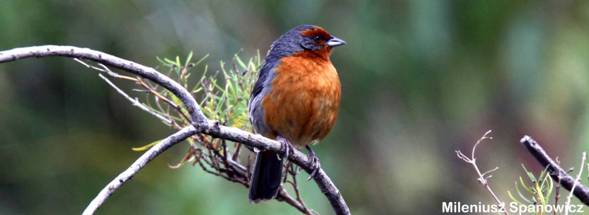
Asociación Armonía / BirdLife International, April 2006
Project coordinator:
Dr. Sebastian K. Herzog, Scientific Director, Asociación
Armonía, Ave. Lomas de Arena 400, Casilla 3566, Santa Cruz de
la Sierra
, Bolivia;
Tel./Fax: +591-3-3568808; E-mail: skherzog@armonia-bo.org
Project summary
The Cochabamba Mountain-Finch is a little-known endangered
species locally endemic to the central Bolivian department of Cochabamba ,
where much of its geographic range falls within the boundaries of poorly
protected Tunari National Park . It inhabits high-Andean Polylepis woodlands, which
have suffered from centuries of strong anthropogenic destruction and
fragmentation. Recent surveys by Asociación Armonía with support from the
Weeden Foundation have encountered only small numbers of individuals at five
out of seven localities with previous records of the species. Alarmed by this
scarcity of observations Asociación Armonía is currently preparing a GIS map
of all Polylepis woodlands
within the known distributional range of the Cochabamba Mountain-Finch, using
satellite images, aerial photographs, and first-hand on-site knowledge. In
order to advance from the baseline biological assessment to more applied
conservation work, we propose the following four project components: (1)
Completion of the biological assessment by carrying out mountain-finch surveys
in at least 10 unstudied woodlands identified by the GIS map to potentially
hold a population of the species; (2) Training of the 29 park guards of
Tunari National Park and initiation of a park guard monitoring program of Polylepis birds; (3) Environmental
education work following the “Schoolyard Ecology” and “Inquiry Cycle”
initiatives in two to four peasant communities that have custody over key
sites for Cochabamba Mountain-Finch protection; (4) Socioeconomic assessments
in the same peasant communities to assist in the development of strategies
that will improve the livelihood and quality of life of rural communities in
exchange for increased long-term protection of Polylepis woodlands.
Project goal
The goal of this project is to ultimately protect the
Cochabamba Mountain-Finch and its habitat facilitated through (1) increasing
our knowledge of the species's precise spatial distribution, (2) supporting
the National Park Service through park guard training, and (3) working with
local communities to promote sustainable land use practices.
Project
area
Polylepis forests
on the northern, western and eastern slopes of the Cochabamba basin, between
approximately 17º10'-40'S and 65º30'-66º15'W and 2900-
3900 m
Background
The Cochabamba Mountain-Finch ( Poospiza garleppi ) has one of the most
restricted geographical ranges of all Neotropical birds. It is not only
endemic to Bolivia , but also endemic to a small area in the central Bolivian
department of Cochabamba . Its estimated total range size is a mere
3660 km
Polylepis fuel
wood, Cochabamba , December 2004. Foto: S. K. Herzog
Given this alarming situation, Asociación Armonía started
its first assessment of the current situation of the Cochabamba
Mountain-Finch in October 2003 with support from the Weeden Foundation.
Although the species is known from at least 85-90 scientific museum specimens
collected at 12 different localities, and observations by ornithologists and
bird watchers at some of those sites in recent years (especially in the
easily accessible Liriuni-San Miguel area), our knowledge about its
approximate global populations size, degree of population fragmentation, and
exact spatial distribution was and still is rudimentary at best. Likewise,
there is no information on possible population decline or metapopulation
dynamics (e.g. connectivity between and genetic viability of subpopulations).
In order to establish vital baseline data on the species's
current distribution, relative abundance, and habitat preference, Armonía
hired Cochabamba ornithologist José Balderrrama to conduct surveys using
standard bird census methods at seven known localities of the Cochabamba
Mountain-Finch both at the beginning of the rainy season during
October-November 2003 and at the beginning of the dry season during
April-June 2004. These surveys were accompanied by a botanical study on
species composition and habitat structure of those seven localities, which
totaled
64 ha
Project overview
Here, Asociación Armonía proposes to advance from Phase II
of the Cochabamba Mountain-Finch project, namely the baseline biological
assessment, to Phase III, which will focus on educational and socioeconomic
work with local communities as well as park guard training. The proposed
project will consist of four main components:
(1) Completion of the baseline biological assessment by
carrying out mountain-finch surveys in unstudied areas identified by the GIS
map to potentially hold a population of the species.
(2) Training of park guards of Tunari National Park .
(3) Environmental education work in selected peasant
communities.
(4) Socioeconomic assessments of selected peasant communities.
Below each of these points is explained in detail:
Completion of the baseline biological assessment
The current ground truthing of the GIS mapping results is intended only to verify the mapping of habitat types at a few selected localities that are relatively accessible but have not been visited before. Currently, we do not have sufficient funding for a Bolivian ornithologist to conduct surveys especially in the more remote unstudied sites identified by the GIS mapping as potentially containing mountain-finch populations. Therefore, the first step of the proposed project will be to carry out surveys in as many unstudied localities as possible. Ideally, we will cover every larger (>5 ha) native woodland fragment identified by the digital habitat map, although this may not be feasible, depending on the spatial configuration and accessibility of those fragments. However, we propose to cover at least the 10 most promising sites over a 5-month period, starting in October 2005. To help better select these survey sites, and to contribute to the "ground" truthing of the GIS mapping results, we will conduct an initial reconnaissance over flight by small airplane of approximately three hours. This will also help in defining ground access routes to the remotest habitat patches.
To make field work more efficient, the Bolivian ornithologist will work together with a field assistant, ideally a Bolivian biology student with a strong interest in ornithology, thereby adding a field training component often not provided by Bolivian universities. The team will map in detail all woodlands visited using a hand-held GPS unit, and they will conduct a quantitative assessment of habitat structure (density of native woody plants) and composition ( Polylepis vs. other native woody plants). To determine bird abundances, the ornithologist will use point counts, line transects and a “random walk” approach. Distance between adjacent point count stations and line transects will be at least 200 m where habitat fragment area and dimensions permit. In smaller fragments at least point count stations will have to be spaced at shorter distances from each other.
After the 5-month field surveys we anticipate approximately one month of data analysis and write-up for the ornithologist. He/she will spend one additional month on compiling a field guide to the typical birds of Cochabamba 's Polylepis woodlands (see below) in Spanish and Quechua, the native language of the local peasants.
Training of park guards of Tunari National Park
Although Tunari National Park largely is a paper park it has a total of 29 park guards and four park guard stations. Each station usually is manned with three park guards, which rotate between headquarters and stations on a 2-week basis. Most park guards, however, are poorly trained and mostly unaware of the importance of native woodlands, not only in terms of threatened bird protection, but also regarding their contribution to watershed protection, natural water retention and subsurface storage, and avoiding soil erosion. Both for the training of park guards and environmental education initiatives in local communities we will hire an education coordinator experienced with peasant communities in Cochabamba and with a thorough background in biology and ecology. An increasing number of Bolivian biologists have received formal training in what has come to be known as Schoolyard Ecology and the Inquiry Cycle, an education initiative primarily developed and spearheaded by Peter Feinsinger and adopted by international conservation programs, such as the Audubon Latin America and Caribbean Program. These initiatives have provided a great human resource potential for this and other conservation projects in Bolivia and elsewhere in Latin America .
Park guard training will consist of a series of sessions, both in the class room and in the field, on the basic aspects of the ecology of Polylepis forests, their typical bird species, and their value for watershed protection. Although the organizational details will have to be discussed with the park administration, we are aiming for eight afternoon or morning classroom sessions (totaling four days), followed by two to three full day field trips. Given the rotation schedule of the park guards it will not be possible for all guards to participate in training sessions at the same time, and each session will have to be held twice. The ornithologist will be involved in the teaching when practical and theoretical ornithological aspects are treated and during the field trips, where guards will also have the opportunity to practice watching birds with binoculars. Here, the ornithologist will pay particular attention to identifying park guards with previous knowledge about and/or a pronounced interest in birds.
To start developing or improving the skills of the park guards in the field identification of Polylepis birds during the training workshops the ornithologist will compile a simple field guide to the typical birds (ca. 80 species) of Cochabamba's Polylepis woodlands. Art work will be scanned from “Birds of the High Andes” by Jon Fjeldså and Niels Krabbe. Jon Fjeldså already is collaborating in an initiative of Asociación Armonía to obtain funding for a more technical field guide to the birds of the Bolivian Yungas, which will also feature some of his artwork from the high Andes field guide. For the Polylepis conservation training field guide, in addition to the artwork, the ornithologist will write for each species a simple text in Spanish and Quechua on identification features and natural history. Pages will be printed on a color printer, plastic-laminated, and spiral-bound to produce a practical, cost-efficient teaching guide to be used during park guard training. Each guard will receive his personal copy.
At the end of the general park guard training, between five and ten guards with interest and talent in bird watching and identification will participate in an additional workshop on simple bird monitoring techniques. Four pairs of binoculars will be donated to the park to be used by those guards, ideally with one pair of binoculars at each of the four park guard stations. The binoculars will be donated under the agreement that park guards will make at least two visits over the six months following the workshop to a Polylepis woodland in the vicinity of each park guard station and compile a bird list during those visits, which is intended to be the first step of a bird monitoring scheme run by the park guards.
Environmental education work in selected peasant communities
Once the biological baseline assessment has identified the population strongholds of the Cochabamba Mountain-Finch it will be necessary to start educational work with those peasant communities that have custody over the respective Polylepis woodlands. This will be the most difficult and unpredictable component of the project. The long-term overall goals, as in many rural conservation education projects, are (1) to demonstrate and convey to the community that by using Polylepis forests sustainably the community itself will benefit from better ecosystem services provided by a “healthy” natural environment, and (2) to develop strategic partnerships aimed at improving the livelihood and quality of life of rural communities in exchange for increased long-term protection of native habitats.
The number of communities to be included will depend on several factors, but primarily on the location of important mountain-finch populations and the willingness of communities to participate in the project. At this stage we propose to work with at least two, but no more than four communities. Once the important mountain-finch populations have been identified the education coordinator will first investigate if the respective peasant communities already have a history of NGO involvement or even current projects before the initial contact with community leaders. The first meetings with community leaders and elementary school teachers will be held jointly with both the education coordinator and the socioeconomic specialist, and the two will continue to collaborate closely during their work with the communities.
We estimate that these first meetings will take place over a four to six week period. Once we have gained the trust and support of local authorities and, most importantly, have taken into account their suggestions, requests, and conditions for collaboration, the education coordinator and the socioeconomic specialist (see below) will set out to conduct interviews with a representative number of families in each community (at least 10 families in small and at least 20 in larger communities). Through these interviews, we will learn about the peasants's perception of native woodlands, the degree of understanding of the ecosystem services they provide, and the types and intensity of use of the woodlands for agricultural and domestic purposes. Following these interviews the education coordinator will hold two two-day community-wide Inquiry Cycle workshops in each community. This strategy has already been applied successfully in one rural community in the Cochabamba basin. The Inquiry Cycle involves a process of thought and action that, in three commonsensical steps, provides a universal framework for investigation. The first step consists of framing a relevant question. In the second step, called “first-hand experience”, information required to answer the question is collected. Finally, the findings are analyzed and reflected upon.
The second level of educational work will consist of Schoolyard Ecology workshops with the elementary school teachers. Depending on the number of teachers, distance between communities, and other logistical considerations, these workshops will either be integrated in the park guard training program or the Inquiry Circle workshops in each community. Teachers also will receive at least 10 copies of the Polylepis bird field guide per school (the number of copies given to each school will depend on the number of schoolchildren). Schoolyard Ecology is an education initiative devoted to make ecology and conservation science accessible to schoolteachers, children, and parents through first-hand experience of local ecological processes and human effects on the environment. The initiative is designed to create a collaborative team of ecologists and teachers to explore ways in which they can take advantage of their most immediate environment, the schoolyard, in order to teach the fundamentals of scientific inquiry. It encourages children and teachers to ask questions about the local environment and after research and conscientious analysis, to apply this knowledge to diverse situations that are locally relevant, challenging, and fun (= the Inquiry Cycle).
Socioeconomic assessments of selected peasant communities
The socioeconomic assessments will be the first step in the development of strategies aimed at improving the livelihood and quality of life of rural communities in exchange for increased long-term protection of native habitats. As mentioned above, the socioeconomic specialist will conduct interviews with a representative number of families in each community (at least 10 families in small and at least 20 in larger communities). Through these interviews we will learn about (1) the ways in which access to woodland resources is regulated in each community, (2) the types and intensity of use of the woodlands for agricultural and domestic purposes, and (3) the main international, regional, and local economic variables that drive the presumably unsustainable use of the native woodlands. This baseline knowledge is vital for developing economic strategies that will provide alternative sources of income based on non-destructive and truly sustainable natural resource use.
Project outcome
This project will complete the process of obtaining the vital baseline data required for (1) determining the key areas for protecting the Cochabamba Mountain-Finch, (2) calculating the first precise estimate of global population size based on hard data (survey data, availability of habitat), and (3) assess the degree of fragmentation and patchiness of mountain-finch subpopulations.
As a considerable proportion of the species's global population certainly occurs in Tunari National Park, the project will increase the level of training, ecological knowledge, and environmental awareness of all park guards. It will also identify those guards with talent and interest in observing birds and initiate the first step towards establishing a park guard monitoring program of Polylepis birds.
Given that land stewardship over the species's habitat ultimately lies in the hands of local peasant communities situated in a very poor area of Bolivia , it is imperative that conservation strategies must be in accordance with the socioeconomic interests and targeted at increasing both the livelihood and the environmental awareness of the local communities. This project will provide the first step in that direction. It will create the baseline socioeconomic data vital for developing alternative economic strategies that are mutually beneficial to the communities and the Cochabamba Mountain-Finch and its natural habitat. It will also increase the awareness and understanding of basic ecosystem processes of local peasants and help them to understand the variety of benefits they receive from the continued existence of extensive, healthy Polylepis woodlands. Needless to say, this type of work with local communities is a long-term process and will need to be continued after the culmination of this 1-year project.
Budget
Item |
Cost (US$) |
Personnel |
|
Project coordinator |
1900 |
Field ornithologist (7 months) |
3500 |
Ornithological field assistant (5 months) |
500 |
Environmental education and park guard training (8 months) |
3200 |
Socioeconomic assessment of selected peasant communities (5 months) |
2000 |
Travel Expenses |
|
Travel between Cochabamba and Santa Cruz |
500 |
Over flight |
500 |
Ornithological field surveys |
800 |
Environmental education, park guard training, socioeconomic field
surveys |
600 |
Subsistence |
|
Meals in Cochabamba (project coordinator) |
160 |
Meals during ornithological field surveys |
500 |
Meals during education, park guard training, socioeconomic field surveys |
500 |
Meals for peasant community members and park guards during workshops |
1500 |
Equipment |
|
Binoculars (6 pairs) |
1800 |
GPS |
250 |
Field equipment |
100 |
Computer |
1000 |
Supplies |
|
Field supplies (batteries, first aid kit, notebooks, etc.) |
120 |
Teaching supplies (photocopies, folders, pens, etc.) |
200 |
Office supplies (printer ink, paper, CDs, etc.) |
200 |
Printing costs |
|
Bird guide for Cochabamba Polylepis forests |
650 |
Communication |
|
Long-distance phone calls |
300 |
Subtotal |
20,780 |
Armonía Conservation Center Support |
|
Administration & accounting, use of office space, computers, data
base, library, etc. |
3,117 |
Total |
23,897 |
|