If you are using this free guide, please support Bolivian Bird
conservation by designating
a tax deductible donation to Asociacion Armonía through ABC (click Armonia logo)
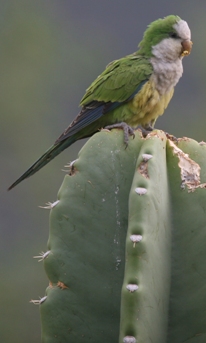
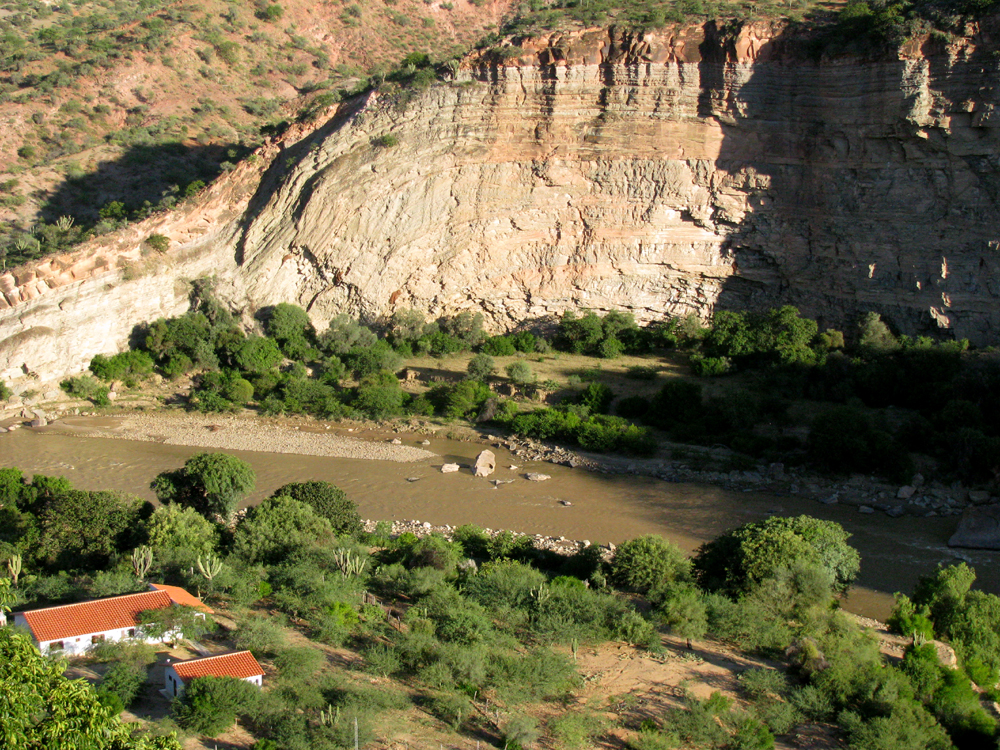 In 2009, Asociacion Armonia created the 124 acre Red-fronted Macaw Reserve, protecting the most important breeding cliff for this threatened species. On the reserve is the Red-fronted Macaw Ecolodge which helps protected the Macaw, while all proceeds go to the local communities and the protection of the Red-fronted Macaw reserve. The general opinion of the Ecolodge is "fantastic". The lodge is situated across the river from a massive hard rock breeding cliff which serves as the most important breeding area for the Red-fronted Macaw (bird photos by Mileniusz Spanowicz). For much of the breeding period the area is full of activity with not only Red-fronted Macaws, but also Mitred Parakeets, Yellow-chevroned Parakeets, Blue-fronted Parrots, and Cliff Parakeets flying back and forth from the cliff face. One hundred and twenty-one bird species have been recorded at the reserve (see Red-fronted Macaw Reserve Birds List). There area is frequently visited by Andewan Condors
 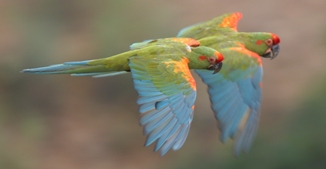 and Peregrine Falcons, including a leucistic morph (more pale than the average bird) in 2007. One hundred and thirty birds have been found in the area (see Red-fronted Macaw birding guide below).
The Lodge is based facing a large cliff where the Red-fronted Macaw breeds with the Bolivian Cliff Parakeet (a different form of the Monk Parakeet), Mitred Parakeet, and Bolivia Blackbirds (endemic). This desert habitat holds a regional specific bird community,
with such distinctivespecies as the White-eared Puffbird, Greater Wagtail Tyrant, White-tailed Plantcutter, Grey-crested Finch, Spot-fronted Woodpecker, Apolomado Falcon, Ultramarine Grosbeak, and Cliff Flycatcher. During the Red-fronted Macaw breeding season (November- to early May) the macaws are constantly present, seen flying in pairs, families, and groups. Outside of the breeding season the Red-fronted Macaw is less common, but groups are seen daily often as the birds forage near the river and at dusk group for a communal roost.

As in most desert environments, the best birdwatching is done close to the river. A nice long morning hike is to leave the lodge walking down towards the river. Follow the beach down river to the large footbridge, cross and travel up river along a trail which 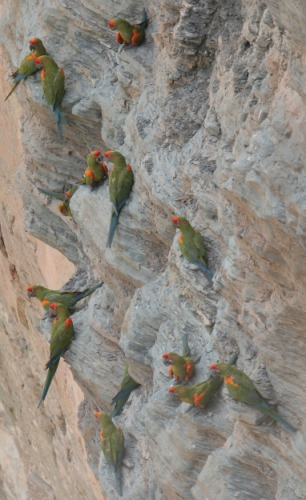 travels below the cliffs and eventually weaves up the cliff edge to the main road. You can birdwatch along the road back to the town of Perrereta and take the footbridge back to the lodge. The road usually has almost no traffic. The trail travels into two valleys with more Red-fronted Macaw nests. Go softly as though the macaws are usually up in the cliffs, at any time they can foraging in the trees and come to the river for a drink.
Another possibility is to walk down to the river from the lodge, and birdwatch upriver follow the trail on the edge of the aqueduct. This trail will take you to a along a cliff edge but to open up again into another forested area. Another taller forest that could be interesting exists down river on the San Carlos side passed the footbridge. Also you can be guided to ancient Inca ruins an hours hike up the slope from the lodge.
Logistics: You must have a reservation to visit the lodge.
Asociacion Armonia in its attempt to create sustainable conservation
for the Red-fronted Macaw has supported the communities of Amaya, Perrereta, and San
Carlos in their creation of the Red-fronted Macaw ecolodge,
financially supported by Ben Olewine, the Royal Zoological Society of Scotland Conservation Fund, and CEPA- Conservation des Espèces et des Populations Animales. The
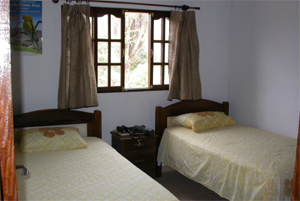
lodge can receive up to 14 guests with running water, electricity,
and hot showers.
Administration of the lodge is developing with the local community. Presently you need to make a reservation to visit the lodge, which you can do through Bird Bolivia. Bird Bolivia includes the Red-fronted Macaw lodge in the Bolivia's Diversity tour and Eight Day Santa Cruz tour.
 As it is called, the old road from Santa Cruz to Cochabamba is partially paved, traveling up the Andes to Samaipata and onward toComarapa. In a vehicle you want to travel this road to the town ofSamaipata- from Santa Cruz to Samaipata is about 3.5 hours drive. Land Hausoffers clean rooms, with a restaurant and a nice salad bar. We also recommend Latin Café on themain paved street. In Samaipata you can check theInca ruins and Samaipata Yungas. From Samapaita you need to drive further along the paved road for 87 km, to the road block La Palizada. From here you are taking the dirt road to Sucre. This is a rough road with many tight turns which requires a few steep high altitude climbs- so make sure your vehicle is in good knick. One hour in, or 23 km you will come to the last town called Saipina.
This is your
last chance for fuel (a bit overpriced), cold drinks, hardware and luxurious supplies. Coming intoSaipina, at the roundabout on the corner of the plaza, turn left and in a few meters you will pass over a bridge. From Saipina you travel another 42 km (65 km on dirt road) to the town of Perrereta. There is a government sign that has the name on it, but also Perrereta is distinct that the road comes to a tight curve right in the middle of the town (really just 20 houses along the road). We suggest asking for DonMartin for a place to park your vehicle. There is a 2 km walk to the lodge. You need to walk down to the river, take the footbridge across, and follow a farming field path to the main town of San Carlos and the 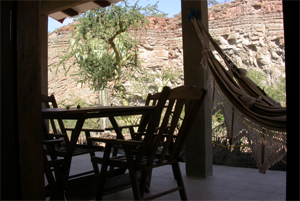 far left to the lodge. Your drive from Santa Cruz to Perrereta could take 7 to 8 hours depending on how you go up hill and take tight turns.
Now it is possible to arrive without a vehicle, but a bit tricky. We have been told there is a bus that travels from Santa Cruz to Perrereta on Tuesdays and Fridays, and another from Perrereta to Santa Cruz on Thursday and Sunday. There is also a daily micro bus to Saipina- where you would have to contract a taxi to Perrereta. Another option would be the daily many buses that travel to Sucre from Santa Cruz, but they pass around 3 am in Perrereta. I am sure you would be able to wave one down, at around the same time to return- but I would suggest trying to reserve a prepaid seat- though most likely that is too complicated for any of these bus companies.
 Another option is to take a tour of the general area with Bird Bolivia. To make the trip more enjoyable, we suggest birding your way up to Samaipata, spending a few nights as Los Volcanes, a night in Land Haus (cheap) or Campeche lodge (middle but very nice), and then birding and enjoying the drive to Red-fronted Macaw lodge. The trip is very scenic. The return trip is mostly down hill and can be done in one swoop without much problem.
Help protect Bolivia's Birds with a tax deductable donation designated to Armonia through their partner World Land Trust-US.
BIRDING AT RED FRONTED MACAW LODGE
By Bob Henderson
Birders are welcome in this valley. Enjoy your stay and birding experience.
Remember that you are a guest of the farmers in this valley whose livelihood depends on what they produce here.
• Do not damage the aqueducts that water the fields.
• Do not walk on cultivated fields. There are paths around them. Stay on the paths.
• Respect the farmers’ livestock.
• Respect the farmer’s privacy as you walk through the neighborhood.
The best birding will be along the river front. Search along the riverbanks and the riparian floodplains. Also view the cultivated land stretching north away from the river.
The following are some general guidelines for finding birding trails. The list is by no means exhaustive, but does provide direction to the most productive birding spots. A general map of the valley is attached.
1. Proceed from the lodge toward the river. Walk to the aqueduct and follow it to the right (west). From this path, you can scan the trees on both sides of the aqueduct and also view the river and shoreline. When you are confronted by a large rock on the path, you should return. You can get around the rock by crossing the aqueduct and then recrossing it, but you will soon be confronted by another rock which completely blocks the path. Do not proceed beyond this rock. The path becomes treacherous at this point.
When returning on this path, about ½ the way back, there is an arch in the path to the left. A trail leads off the top of the arch at a 45 degree angle. You may take this path along the face of the cliff to view a different part of the river edge. This path will lead you to the back of the lodge.
2. Proceed from the lodge towards the river, but do not go down hill as far as the aqueduct. Turn left. Bird along this path. You will enter the compound of a few adobe homes. Go through the gate on your right which leads to the fields on the north side of the river. Follow the path next to the aqueduct and then turn right at one of the paths between the cultivated fields. You will be able to see the foot bridge spanning the river. This is your goal. Cross the river on the bridge and turn to the right (you will need to leave the bridge to the left and then do a 180 degree turn under the bridge.
Bird along the riverside on any of three levels: the shoreline, the middle floodplain or the upper flood plain. As you get upriver, make sure to climb the wall leading to the upper flood plain as it provides good birding as well as good views of both the Cliffside and the river.
You can bird along the river beyond the lodge and make excursions into the badlands between the cliffs. There is also a goat trail up the side of the cliff starting at a valley beyond the lodge. This is a difficult climb and should be undertaken only by the fittest.
During the dry season, it may be possible to cross the river back to the lodge on a series of rocks a short distance to the west of the lodge. During the wet season, the path must be retraced to the bridge to return to the lodge.
3. Proceeding north from the lodge, you can follow the road that leads around the edge of the valley. A slow walk along the road may prove to be productive for some species that may not be found along the river front. It may also provide an opportunity to see parrot species that are feeding during the day in the trees near the road. The road takes a “U-shaped” route from the lodge to the north side of the valley and back to the river, downstream of the foot bridge. Once you get back to the river, you can take the paths along the river or beside the fields and trace your way back to the lodge.
The road crosses a wide wadi about 200 meters beyond the school. During the dry season, it is worthwhile walking up the wadi to a point where a large tributary intersects on the right. During the wet season, it may be possible to walk up the right side until getting to the tributary.
Birding north and west of the cemetery located at the northwest corner of the road and wadi can be productive. Take care not to go so far west that you miss the road as it turns to the south.
As you bird the road going toward the river, there are a couple of stub roads on the left that can be walked. There is also a very thorny woodlot on the left as you approach the river. There are some footpaths that lead to the interior, but following them may not be worth the cuts to your skin.
4. Another variation of path 2, above, is to go through the gate west of the fields and follow the aqueduct along the side of the fields rather then turning right to cross them. Just before the aqueduct makes a significant bend to the right, you should take a road to the left that leads next to a cane sugar processing area and get back to the main road. To travel further on the path next to the aqueduct is not advised.
5. Mitred Parakeets roost in the trees along the south side of the river in front of the lodge. Early risers will hear them leave their roost, but the best time to view them is in the evening. They will fly in about ½ hour before sundown, crying loudly, and can be easily seen.
Red-fronted Macaws nest in crevices in the cliffs across from the lodge and roost in them other times of the year. Although you can see them flying around during the day, the best time to observe them is early morning and late afternoon. They also make a lot of racket when flying or sitting.
Cliff Parakeets build nests from thorny bushes on the cliff face across from the lodge. The thorny bushes turn red when dried. The clumps of red vines on the cliff face are the colony nests of the parakeets. Their cry is a continuous shrilled call and will be heard throughout your stay during daylight hours.
Blue-crowned Parakeets roost in crevices in the cliffs. They fly in silently and give only a quick glimpse. They are better observed feeding during the day along the valley road.